Today we leave Dar es Salaam once again for Iringa, our penultimate journey between the two cities. The next time we travel this road we will hopefully be laden with artifacts and well-formed ideas for our theses. For now, I anticipate seeing lots of villages, baboons, and construction workers. If we’re lucky, we’ll continue our lucky elephant sighting streak. In any case, it’s going to be a long trip. So, for your enjoyment, here are the top 3 most useful things that I brought to Africa.
3. My iPod.
The credit for this should really go to my boyfriend, my sister, and my brother-in-law who bought me a 40 GB iPod when I graduated with my undergraduate degree. Back at home, I often neglect it in favour of my beloved iPhone, but it is utterly indispensible out here. Musical devices have a bad reputation among travelers because they can discourage people from meeting others and fully experiencing a new place. However, I don’t think many tourists face the same challenges that we do in the normal course of field work. Our existence is a real mix of highs and lows, and when things get too overwhelming there is nothing more soothing than listening to music from back home. It provides an instant link to something that is familiar and seems to take the edge off of whatever we are seeing or experiencing. Although I don’t bring it to the rock shelter or when we are around people, it really helps with the trip between Dar and Iringa, as well as with our daily commute to and from the site. Perhaps most importantly, it really helps with the social aspect of our work here. Even with a team as tightly bonded as ours, sometimes you just feel like wrapping a khanga around your head and pretending that no one is home. We are quite literally with each other 24 hours a day, 7 days a week. We work together, eat meals together, and sleep together. Consequently, the pseudo-solitude that an mp3 player and ear buds can provide is solid gold.
2. Sunglasses, a wide brimmed hat, and sunscreen.
These items might seem like obvious necessities for working in the tropics, but their utility cannot be overstated. Because it’s the dry season, our trip out to the site is apocalyptically bright as the sun reflects off the yellow-white dirt road and the dried mud brick houses. It’s also extremely dusty since both those features are actively eroding in the sun. Before I left, Ben bought me a pair of aviators with legitimate UV protection which I usually end up wearing for at least 4-5 hours a day every day. They allow me to comfortably watch the scenery as well as keep out the dust. Without them, I doubt I could keep my contact lenses from drying out and ejecting from my eyes. However, sunglasses are pretty useless in a shady rock shelter, which is where the oil-skin hat comes in. It provides just enough neck and face protection for short trips out of the rock shelter, and to eat lunch. Also, it handily keeps my hair mostly bug and twig free, which is always a bonus. Sunscreen is the final component of my sun-safety triumvirate. Every morning when I get out of the shower, I put SPF 60 on my entire body, including the parts that will be under clothing. I use SPF 100 on my face. I also reapply at lunch, and whenever I’ve been exposed to direct sunlight for more than 45 minutes. I belong to the school of thought that any skin colour change, including tanning, falls under the heading of sun damage. Archaeologists already tend to have a higher incidence of skin cancers due to their careers spent bent over holes, and I don’t intend to be a statistic. However, staying burn and tan free while working 7° S of the equator has been a constant battle. The sun is winning in that my arms and hands are getting tanned, but still far less so than my colleagues (who will not be winning any awards for sun safety any time soon). If I can come home at the end of the summer with only a mild tan and no burns, then I’ll consider my regime a success.
1. Malarone
Of the available options, we decided to take Malarone as our anti-malarial drug of choice because it is reputed to have the least side effects. It’s also the most expensive at $5 per pill, which is compounded by the fact that it has to be taken daily. The cost for 80 days was about $412, although I paid $9 with my outrageously good drug plan. Cost aside, Malarone is a miserable drug. It’s taken both to prevent and cure malaria, and consequently is not what I would call a mild medication. After we had been taking it for about 15 days, I started to notice that my stomach hurt and was upset almost constantly. I couldn’t seem to get any relief, even after a few days of only eating plain rice. I established that it wasn’t anything in the food or water after two rounds of antibiotics didn’t seem to have any effect. I’m almost positive that I am reacting to our anti-malarial pills. Considering that chronic stomach problems are listed within the first few possible side effects, this is something I’ll probably have to deal with for the next 40 days. It’s been slowly getting better as I learn what foods enrage the Malarone monster, but there’s not much I can do. Our team has also been experiencing other side effects, including fatigue, insomnia, mouth cuts, and extremely vivid dreams and nightmares. However, as awful as the anti-malarial pills are, the disease is infinitely worse. And we just can’t seem to avoid mosquitoes. From the hot and muggy climate of Dar es Salaam to the cool and dry weather in Iringa, they follow us like paparazzi. Although the mosquito nets help while we’re sleeping, you can’t exactly walk around under one all day long. I think I always have at least 1-2 bites on the go, and more when we’re in Dar es Salaam. Oh, and these scary tropical mosquitoes laugh in the face of bug spray. It’s absolutely critical that we take a preventative drug so we don’t become infected with the parasite. As much as I truly hate taking Malarone, I would much rather do so now than suffer the consequences of malaria later on.
Other items that have proven highly useful have been the school supplies my parents sent, my two cameras, my computer, and of course my journal. However, the items on my list above are those that I can’t live without. If I’m ever stranded on a desert island, I’ll cross my fingers for the same survival kit.
skip to main |
skip to sidebar
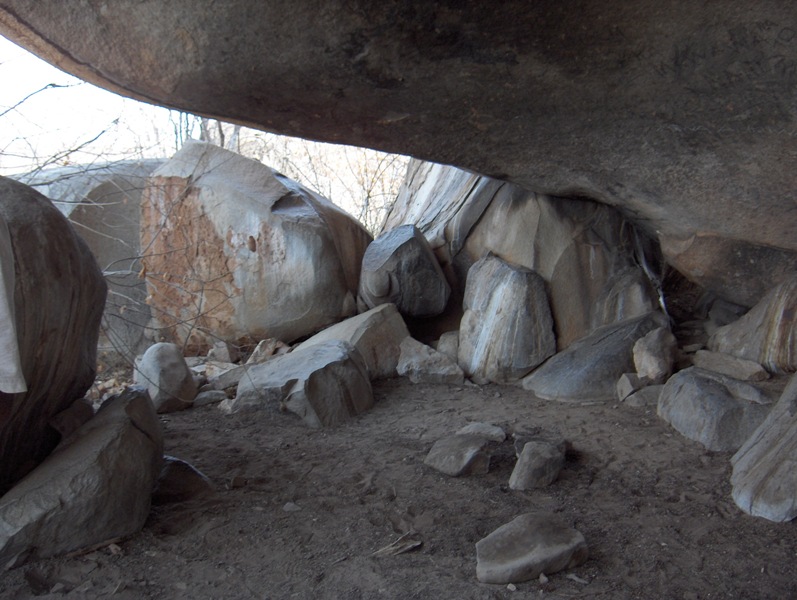
Mapango, or just Pango, are rock shelters. These posts chronicle my experiences in a granite pango in southern Tanzania, as well as other hijinks from the field.

About Me
- Ebeth
- My name is Elizabeth and I'm an archaeologist. I'm also a palaeoanthropologist, a bioarchaeologist, and a physical anthropologist, depending on the day. I'm spending the summer excavating bones (and other treasures) from an archaeological site in Tanzania. Otherwise, I'm a typical graduate student who enjoys coffee, reality television, and long walks on the beach.
No comments:
Post a Comment