
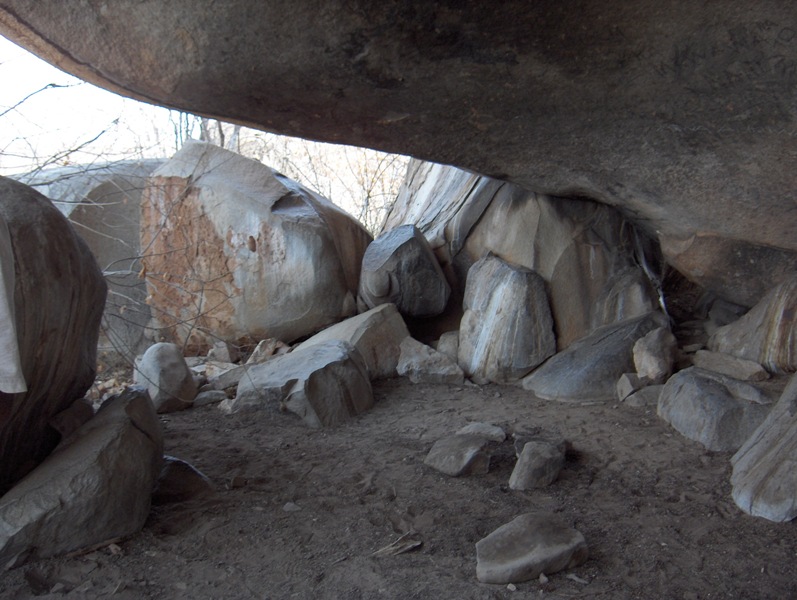
I’m concerned about an imminent goat invasion. Iringa is a goat-heavy region in general, and there is a particularly robust population in the immediate vicinity of our site. They are a major part of the Maasai lifestyle, along with cattle, so we often see them around. They are usually accompanied by Maasai kids and a dog or two, charged with keeping the goats in line. Although we’ve been hearing them from the first day in our rock shelter, lately they’ve been getting closer and closer. I think it’s because their tiny herdsmen have also been getting closer in the pursuit of candy. It started with finding goat presents on the path up the hill to our site. Next, the highly audible bleating started. Finally today, I spied them in room 2 of the rock shelter, which is connected to room 1 by a narrow opening. A few goats even looked like they meant to come straight through. And what would we do then? Fight to the death for our pango?
While discussing goats at lunch, Katie, Jenn, and I got on the topic of reality vs. presentation when it comes to archaeological research. In reality, there is always a healthy mix of unavoidable disaster and human error operating behind the scenes. Walls collapse, quads are mixed up, photos are lost, and curious visitors make off with artifacts. However, none of those points ever make it into archaeological publications. From the perspective of the academy, archaeological sites are tidy little experiments in which hypotheses are tested and results are generated. Of course, no field work on earth is so straightforward. As Katie put it, “archaeological publications are one big lie.” Our site has been pretty fortunate so far, but for a few unscheduled campfires, wall collapses, and ominous sandal prints around our trench. However, what do I tell my committee if goats charge the site while we’re gone and get stuck in our large hole? And thrash about and destroy the entire structure? And I’m unable to finish my research because of goat sabotage? These are the things I think about. I’m watching you, goats.

How is an archaeological site an 'experiment'? Is it not merely an observation?
ReplyDeleteAt our university (and at most), archaeology is considered a social science so I use the term experiment in that sense. We test hypotheses, we have controlled and maniuplatd variables, we generate results, and we draw inferences at the end. Completed excavatons are then used to generate new hypotheses and theories about the past. A site can be excavated in a multitude of ways, so I think that the method and research design chosen by any one team is a kind of experiment. Our observations are part of the active process of excavating.
ReplyDeleteWhat is your hypothesis? What are your controlled and manipulated variables? What do you hope to discover?
ReplyDeleteMy travel blog isn't really the appropriate place to discuss our research design (especially because I have to protect certain details about the site), but feel free to email me if you're interested in our project and want more information!
ReplyDelete